

- Market Size (2026)
- USD 166.6 Mn
- Forecast (2036)
- USD 223.8 Mn
- CAGR (2026 to 2036)
- 3.0%
Slip on Shoes Market Size, Market Forecast and Outlook By FMI
Summary of the Slip On Shoes Market
- Demand and Growth Drivers
- Consumer preference for convenience-oriented footwear is creating steady demand for slip-on shoes that combine ease of use with casual and semi-formal styling.
- E-commerce expansion is reshaping distribution, with online retailers accounting for 48.6% of sales through product comparison and home delivery advantages.
- Product and Segment View
- Lifestyle applications hold 42.1% of the application segment in 2026, confirming everyday casual use as the primary demand driver.
- Men account for 55.3% of the consumer orientation segment, reflecting preference for laceless convenience in casual and semi-formal footwear.
- Online retailers lead distribution at 48.6%, the highest digital share among casual footwear categories.
- Geography and Competitive Outlook
- The USA (3.1%) and South Korea (3.1%) lead growth, driven by casual dress code normalization and strong e-commerce purchasing behavior.
- The EU (3.0%) sustains demand through sustainable footwear preferences and established casual fashion culture.
- The UK (2.9%) and Japan (2.9%) maintain steady demand reflecting mature markets with premium comfort positioning.
- Analyst Opinion
- 'Companies that can combine comfort innovation with sustainable materials and digital-first distribution are positioned to differentiate in the slip on shoes market over the forecast period,' says Rahul Pandita, Principal Consultant at FMI.
- The slip on shoes market is a mature category sustained by convenience-driven consumer behavior and casual lifestyle trends.
- Adoption reflects consumer preference for footwear that eliminates friction in daily routines while maintaining style versatility.
- Growth is shaped by e-commerce dominance in distribution and the increasing importance of sustainability as a brand differentiator.
Key Takeaways, Market Size, and Forecast
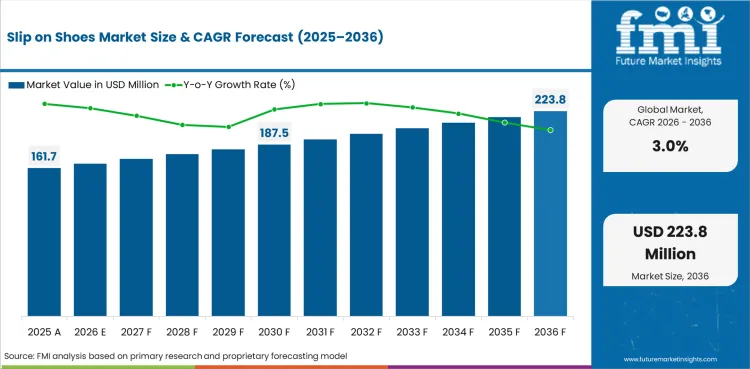
- The slip-on shoes market was valued at USD 161.7 million in 2025.
- The market is set to reach USD 166.6 million by 2026-end and grow at a CAGR of 3.0% between 2026-2036 to reach USD 223.8 million by 2036.
- Leather will dominate with a 27.4% share.
- Lifestyle will lead with a 42.1% share.
- By 2036, the slip-on shoes market is expected to be worth USD 223.83 million.
- From 2026 to 2036, the market is projected to expand at a CAGR of 3%.
- The market is projected to create an incremental opportunity of USD 57.28 million between 2026 and 2036.
- In 2026, men is expected to account for 55.3% of the consumer orientation segment, driven by established preference for convenience-oriented casual and semi-formal footwear among male consumers across work and leisure settings.
- USA (3.1%) and South Korea (3.1%) are two of the fastest growing markets in the world.
Slip On Shoes Market Definition
The slip on shoes market encompasses footwear designed without laces, buckles, or straps, characterized by ease of use and minimalist design, segmented by material, application, consumer orientation, and sales channel.
Slip On Shoes Market Inclusions
Market scope encompasses all commercially traded slip on shoes market products categorized by material, application, consumer orientation, sales channel. The range of revenue sizes is from 2026 to 2036.
Slip On Shoes Market Exclusions
The scope does not include products that fall outside the defined segmentation taxonomy, raw materials not processed for end-use applications, or adjacent product categories that do not compete directly within the slip on shoes market framework.
Slip On Shoes Market Research Methodology
- Primary Research: FMI analysts conducted interviews with industry participants, product manufacturers, distributors, and end-use application specialists across key markets.
- Desk Research: Combined data from industry associations, regulatory bodies, trade publications, and manufacturer disclosures.
- Market sizing and forecasting: Bottom-up methodology aggregating data across segments and regions, with regional adoption curves and cross-validation.
- Data validation: Cross-checked quarterly against global production data and manufacturer-reported information.
Why is the Slip On Shoes Market Growing?
- Consumer preference for convenience-oriented footwear is creating steady demand for slip-on shoes that combine ease of use with casual and semi-formal styling.
- E-commerce expansion is reshaping distribution, with online retailers accounting for 48.6% of sales through product comparison and home delivery advantages.
The slip on shoes market reflects a mature consumer preference for footwear that prioritizes convenience, comfort, and minimalist design. Lifestyle applications dominate at 42.1%, confirming that casual and everyday use remains the primary purchase driver. Men account for 55.3% of consumers, reflecting established preference for laceless footwear in both casual and workplace settings.
Online retailers lead distribution at 48.6%, the highest digital penetration among casual footwear categories. This reflects the lower need for in-store fitting compared to performance categories, as slip-on shoes offer fewer sizing variables. Leather holds 27.4% of the material segment, valued for durability and semi-formal appearance, though synthetic and fabric alternatives are growing as sustainability and price sensitivity increase.
Growth is moderate at 3.0% globally, reflecting category maturity in developed markets and gradual adoption in emerging markets. The USA (3.1%) and South Korea (3.1%) lead growth, driven by casual dress code normalization and digital-first purchasing behavior. Brands that combine comfort technology with sustainable materials are capturing the strongest consumer loyalty within this established category.
Market Segmentation Analysis
- Lifestyle applications hold 42.1% of the application segment in 2026, confirming everyday casual use as the primary demand driver.
- Men account for 55.3% of the consumer orientation segment, reflecting preference for laceless convenience in casual and semi-formal footwear.
- Online retailers lead distribution at 48.6%, the highest digital share among casual footwear categories.
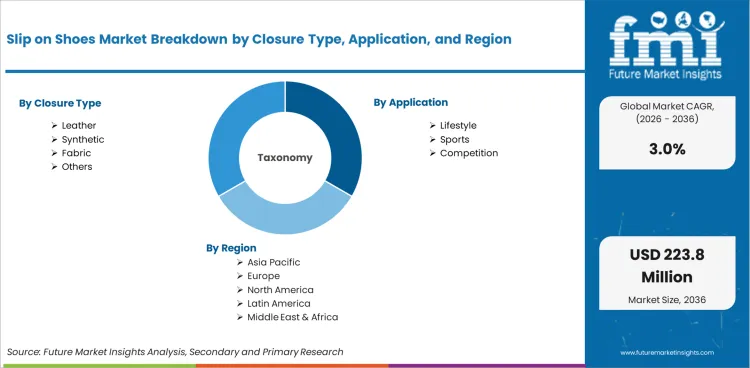
The slip on shoes market is segmented by material (leather, synthetic, fabric, others), application (lifestyle, sports, competition), consumer orientation (men, women), and sales channel (online retailers, hypermarket/supermarket, wholesalers/distributors, specialty stores, multi-brand stores, independent small stores).
Insights into the Lifestyle Application Segment
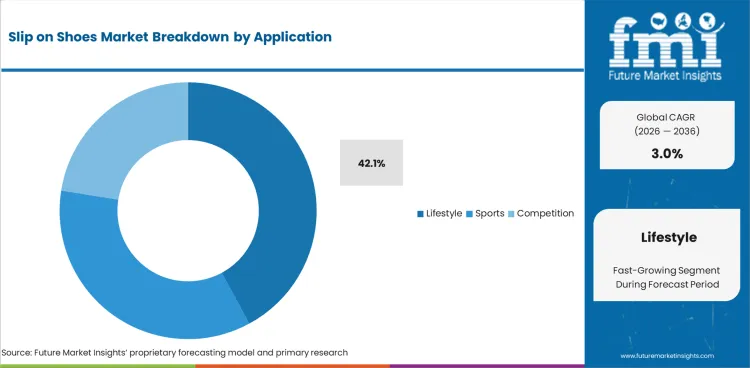
In 2026, lifestyle applications are expected to hold 42.1% of the application segment. Slip-on shoes serve as everyday casual footwear for commuting, shopping, socializing, and light outdoor activities. The category's growth is shaped by the normalization of casual dress codes in professional environments and consumer preference for versatile footwear that transitions between settings.
Insights into the Men Consumer Orientation Segment
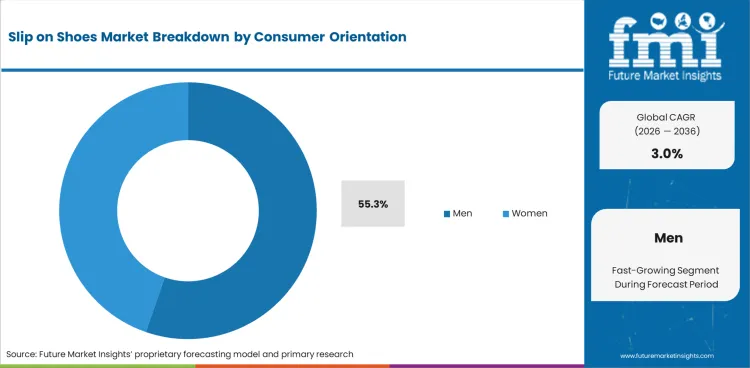
Men represent 55.3% of consumers in 2026. Male consumers value the convenience and speed of slip-on footwear for both casual and semi-formal occasions. Product development for men's slip-on shoes emphasizes comfort technology, arch support, and materials that maintain a polished appearance with minimal maintenance.
Slip On Shoes Market Drivers, Restraints, and Opportunities
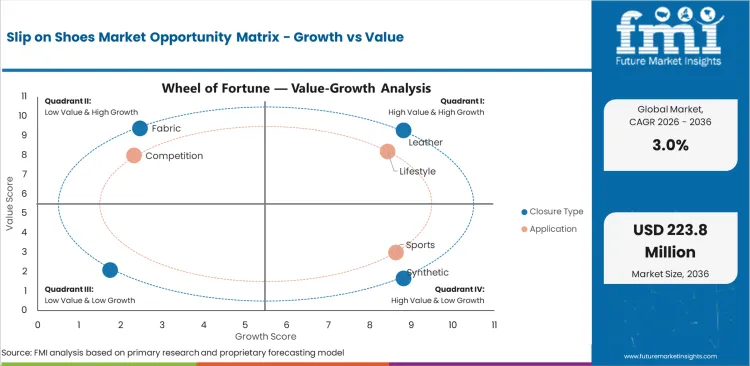
- Casual dress code normalization and convenience-oriented consumer behavior are sustaining steady demand for slip-on footwear across age groups.
- Intense competition from fast-fashion and direct-to-consumer brands creates price pressure and brand differentiation challenges.
- Sustainable and vegan material development is creating opportunities for brands that can align environmental credentials with comfort and style.
The slip on shoes market grows at a moderate pace, sustained by convenience-driven consumer behavior and casual lifestyle trends. Challenges include competitive intensity and fast-fashion price pressure. Opportunities are concentrated in sustainable materials, comfort technology innovation, and expansion of the women's segment.
Convenience-Driven Consumer Behavior
Demand reflects the growing consumer preference for footwear that offers quick on-and-off functionality without compromising appearance. Work-from-home trends, flexible office dress codes, and travel convenience needs support the practical appeal of slip-on shoes across demographics.
E-Commerce and Digital Distribution Dominance
Growth reflects the high e-commerce penetration in the slip-on category, where consistent sizing and lower fitting complexity encourage online purchasing. Brands with strong digital platforms and direct-to-consumer capabilities are capturing higher margins and customer data.
Sustainable Material Innovation
Adoption is increasing due to consumer demand for eco-friendly casual footwear options. Brands like Allbirds and TOMS are positioning sustainability as a primary value proposition, using recycled, plant-based, and ethically sourced materials to differentiate in a commoditized market.
Analysis of Slip On Shoes Market By Key Countries
.webp "Top Country Growth Comparison Slip On Shoes Market Cagr (2026 2036)")
| Country | CAGR |
|---|---|
| USA | 3.1% |
| UK | 2.9% |
| EU | 3% |
| Japan | 2.9% |
| South Korea | 3.1% |
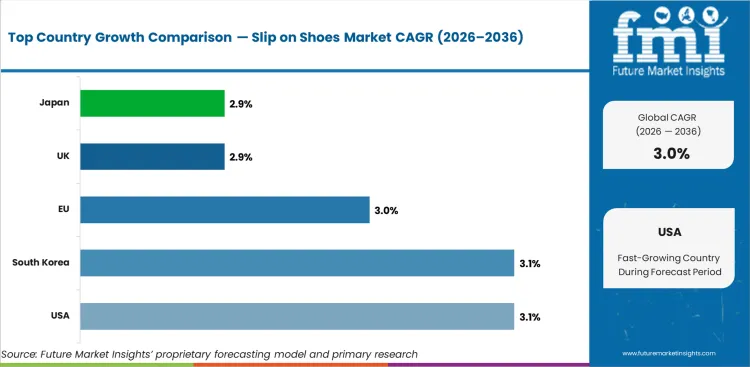
- The USA (3.1%) and South Korea (3.1%) lead growth, driven by casual dress code normalization and strong e-commerce purchasing behavior.
- The EU (3.0%) sustains demand through sustainable footwear preferences and established casual fashion culture.
- The UK (2.9%) and Japan (2.9%) maintain steady demand reflecting mature markets with premium comfort positioning.
The global slip on shoes market is projected to expand at a CAGR of 3.0% from 2026 to 2036. The analysis covers more than 30 countries, and the primary markets are detailed below.
Demand Outlook for Slip On Shoes Market in the United States
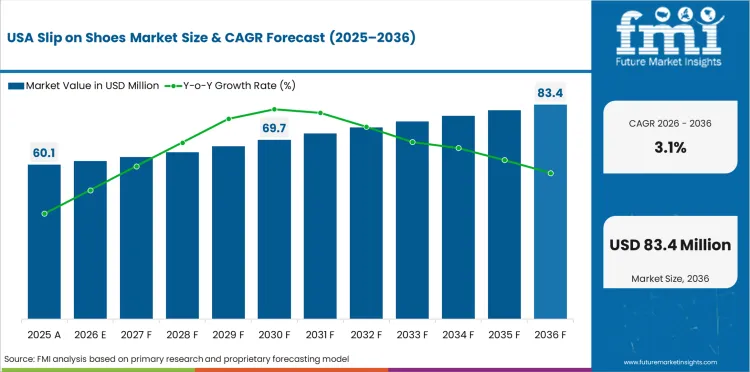
The USA is projected to grow at 3.1% through 2036, supported by casual dress code adoption, strong e-commerce infrastructure, and comfort technology innovation.
- Casual dress code trends sustain everyday slip-on demand.
- E-commerce infrastructure supports digital-first purchasing.
- Comfort technology innovation drives product upgrade cycles.
Future Outlook for Slip On Shoes Market in the United Kingdom
The UK is projected to grow at 2.9% through 2036, driven by casual lifestyle adoption, sustainability preferences, and established retail distribution.
- Casual lifestyle adoption supports consistent slip-on demand.
- Sustainability preferences influence material and brand choices.
- Established retail distribution maintains product accessibility.
Opportunity Analysis of Slip On Shoes Market in the EU
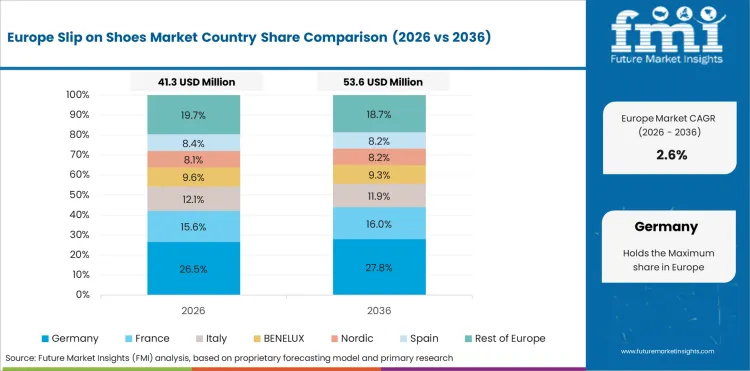
The EU is projected to grow at 3.0% through 2036, reflecting sustainable fashion preferences, casual footwear culture, and premium product positioning.
- Sustainable fashion preferences drive eco-friendly product adoption.
- Casual footwear culture sustains broad-based demand.
- Premium positioning supports higher average selling prices.
In-depth Analysis of Slip On Shoes Market in Japan
Japan is projected to grow at 2.9% through 2036, driven by convenience-oriented consumer culture, high quality expectations, and indoor-outdoor footwear transition needs.
- Convenience culture creates natural demand for slip-on footwear.
- High quality expectations support premium materials and construction.
- Indoor-outdoor transition needs favor easy on-off designs.
Sales Analysis of Slip On Shoes Market in South Korea
South Korea is projected to grow at 3.1% through 2036, supported by fashion-forward casual styling, strong digital retail engagement, and comfort-focused consumer preferences.
- Fashion-forward casual styling drives design-led slip-on demand.
- Digital retail engagement supports e-commerce purchasing growth.
- Comfort-focused preferences sustain demand across age groups.
Competitive Landscape and Strategic Positioning
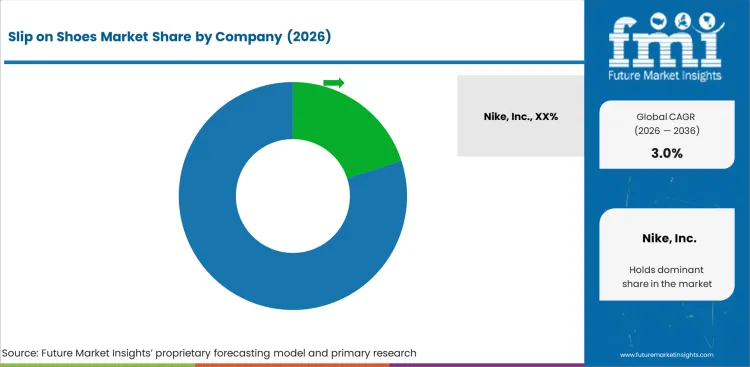
- Nike, Inc. leads with 20.0% market share, supported by broad product range, comfort technology, and global distribution infrastructure.
- Skechers, Vans, and Cole Haan hold strong positions through distinct brand positioning across comfort, lifestyle, and semi-formal slip-on categories.
- Allbirds, ECCO, and TOMS are gaining share through sustainability positioning and direct-to-consumer distribution models.
Nike, Inc. leads the market with 20.0% share, leveraging its extensive casual footwear portfolio and brand strength to serve both athletic-casual and lifestyle consumers. The company's slip-on offerings benefit from cross-selling with its broader sneaker portfolio.
Skechers has built a strong position through Hands Free Slip-ins technology and comfort-first product development. Vans dominates the youth and lifestyle segment with its Classic Slip-On franchise, while Cole Haan serves the semi-formal and business casual market.
Allbirds differentiates through sustainability-first positioning with wool and tree-based materials. ECCO competes on premium comfort through its direct injection sole technology. TOMS maintains its social impact positioning alongside a casual slip-on product range.
Barriers include brand differentiation in a commoditized category, price competition from fast-fashion alternatives, and the need for comfort technology investment to justify premium pricing. Strategic priorities include sustainable material adoption, comfort innovation, and women's product line expansion.
Key Companies in the Slip On Shoes Market
Key global companies leading the slip on shoes market include:
- Nike, Inc. (USA), Adidas AG (Germany), Skechers USA, Inc. (USA), Vans, VF Corporation (USA), Puma SE (Germany), Cole Haan (USA) have strong market infrastructure, established relationships, and broad product portfolios.
- Clarks (UK), Allbirds (USA), ECCO (Denmark), TOMS Shoes (USA) have established positions through specialized capabilities and focused strategies.
Competitive Benchmarking: Slip On Shoes Market
| Company | Comfort Technology | Design Range | Distribution Network | Sustainability |
|---|---|---|---|---|
| Nike, Inc. | High | High | Strong | High |
| Adidas AG | High | High | Strong | High |
| Skechers USA | Very High | High | Strong | Medium |
| Vans (VF Corp.) | Medium | High | Strong | Medium |
| Puma SE | High | Medium | Strong | Medium |
| Cole Haan | High | Medium | Moderate | Medium |
| Clarks | High | Medium | Strong | Medium |
| Allbirds | High | Low | Moderate | Very High |
| ECCO | Very High | Medium | Moderate | High |
| TOMS Shoes | Medium | Medium | Moderate | High |
Source: Future Market Insights competitive analysis, 2026.
Key Developments in Slip On Shoes Market
- In 2025, Skechers USA launched a new Hands Free Slip-ins collection featuring enhanced heel pillow technology for step-in convenience across casual and semi-formal categories.
- In 2025, Allbirds introduced a slip-on shoe made entirely from plant-based and recycled materials, targeting sustainability-conscious consumers in North America and Europe.
Key Players in the Slip On Shoes Market
Major Global Players
- Nike, Inc. (USA)
- Adidas AG (Germany)
- Skechers USA, Inc. (USA)
- Vans, VF Corporation (USA)
- Puma SE (Germany)
- Cole Haan (USA)
Emerging Players/Startups
- Clarks (UK)
- Allbirds (USA)
- ECCO (Denmark)
- TOMS Shoes (USA)
Report Scope and Coverage
| Parameter | Details |
|---|---|
| Quantitative Units | USD 166.55 million to USD 223.83 million, at a CAGR of 3.0% |
| Market Definition | The slip on shoes market encompasses footwear designed without laces, buckles, or straps, characterized by ease of use and minimalist design, segmented by material, application, consumer orientation, and sales channel. |
| Regions Covered | North America, Latin America, Europe, East Asia, South Asia and Pacific, Middle East and Africa |
| Countries Covered | USA, UK, France, Germany, Italy, South Korea, Japan, China, India, 30 plus countries |
| Key Companies Profiled | Nike, Inc., Adidas AG, Skechers USA, Inc., Vans (VF Corporation), Puma SE, Cole Haan, Clarks, Allbirds, ECCO, TOMS Shoes |
| Forecast Period | 2026 to 2036 |
| Approach | Hybrid bottom-up and top-down methodology starting with verified transaction data, projecting adoption velocity across segments and regions. |
Segmentation
Slip on Shoes Market Segmented by Closure Type:
- Leather
- Synthetic
- Fabric
- Others
Slip on Shoes Market Segmented by Application:
- Lifestyle
- Sports
- Competition
Slip on Shoes Market Segmented by Consumer Orientation:
- Men
- Women
Slip on Shoes Market Segmented by Sales Channel:
- Online Retailers
- Hypermarket/Supermarket
- Wholesalers/Distributors
- Specialty Stores
- Multi-brand Stores
- Independent Small Stores
- Other Sales Channel
Slip on Shoes Market by Region:
- North America
- USA
- Canada
- Mexico
- Latin America
- Brazil
- Chile
- Rest of Latin America
- Western Europe
- Germany
- UK
- Italy
- Spain
- France
- Nordic
- BENELUX
- Rest of Western Europe
- Eastern Europe
- Russia
- Poland
- Hungary
- Balkan & Baltic
- Rest of Eastern Europe
- East Asia
- China
- Japan
- South Korea
- South Asia and Pacific
- India
- ASEAN
- Australia & New Zealand
- Rest of South Asia and Pacific
- Middle East & Africa
- Kingdom of Saudi Arabia
- Other GCC Countries
- Turkiye
- South Africa
- Other African Union
- Rest of Middle East & Africa
Research Sources and Bibliography
- 1. World Footwear. (2025). World Footwear Yearbook: Global Footwear Production and Trade Statistics. World Footwear.
- 2. European Commission. (2024). EU Sustainable Textiles and Footwear Strategy. EC.
- 3. USA Bureau of Labor Statistics. (2025). Consumer Expenditure Survey: Footwear Spending Trends. BLS.
- 4. International Labour Organization. (2025). ILO Global Footwear Industry Report. ILO.
- 5. Textile Exchange. (2025). Preferred Fiber and Materials Market Report. Textile Exchange.
This bibliography is provided for reader reference.
This Report Answers
- Estimating the size of the market and revenue potential from 2026 to 2036.
- Segmentation by material, application, consumer orientation, and sales channel.
- Insights about more than 30 markets across key regions.
- Analysis of comfort technology, sustainable materials, and design innovation trends.
- Assessment of the competitive landscape and brand positioning.
- Identifying investment opportunities in sustainable footwear and women's product expansion.
- Tracking distribution channel shifts and e-commerce dominance.
- Delivery of data in PDF and Excel formats.
Frequently Asked Questions
What is the global market demand for Slip On Shoes in 2026?
In 2026, the global slip on shoes market is expected to be worth USD 166.55 million.
How big will the Slip On Shoes Market be in 2036?
By 2036, the slip on shoes market is expected to be worth USD 223.83 million.
How much is demand for Slip On Shoes expected to grow between 2026 and 2036?
Between 2026 and 2036, the demand for slip on shoes is expected to grow at a CAGR of 3.0%.
Which consumer orientation segment is expected to lead in 2026?
Men are expected to account for 55.3% of the consumer orientation segment in 2026, driven by convenience and casual footwear preferences.
What is causing demand to rise in the USA?
The USA is projected to grow at 3.1% through 2036, supported by casual dress code adoption and strong e-commerce infrastructure.
What is causing demand to rise in South Korea?
South Korea is projected to grow at 3.1% through 2036, driven by fashion-forward casual styling and digital retail engagement.
What does this report mean by Slip On Shoes Market definition?
The slip on shoes market encompasses footwear designed without laces, buckles, or straps, characterized by ease of use and minimalist design.
Preview the report firsthand - request a free sample
Get SampleGet the brochure for pricing and purchase details.
Get PDFTable of Content
- Executive Summary
- Global Market Outlook
- Demand-side Trends
- Supply-side Trends
- Technology Roadmap Analysis
- Analysis and Recommendations
- Market Overview
- Market Coverage / Taxonomy
- Market Definition / Scope / Limitations
- Research Methodology
- Chapter Orientation
- Analytical Lens and Working Hypotheses
- Market Structure, Signals, and Trend Drivers
- Benchmarking and Cross-market Comparability
- Market Sizing, Forecasting, and Opportunity Mapping
- Research Design and Evidence Framework
- Desk Research Programme (Secondary Evidence)
- Company Annual and Sustainability Reports
- Peer-reviewed Journals and Academic Literature
- Corporate Websites, Product Literature, and Technical Notes
- Earnings Decks and Investor Briefings
- Statutory Filings and Regulatory Disclosures
- Technical White Papers and Standards Notes
- Trade Journals, Industry Magazines, and Analyst Briefs
- Conference Proceedings, Webinars, and Seminar Materials
- Government Statistics Portals and Public Data Releases
- Press Releases and Reputable Media Coverage
- Specialist Newsletters and Curated Briefings
- Sector Databases and Reference Repositories
- FMI Internal Proprietary Databases and Historical Market Datasets
- Subscription Datasets and Paid Sources
- Social Channels, Communities, and Digital Listening Inputs
- Additional Desk Sources
- Expert Input and Fieldwork (Primary Evidence)
- Primary Modes
- Qualitative Interviews and Expert Elicitation
- Quantitative Surveys and Structured Data Capture
- Blended Approach
- Why Primary Evidence is Used
- Field Techniques
- Interviews
- Surveys
- R&D and Innovation Heads
- Technical Specialists
- Domain Subject-matter Experts
- Scientists
- Physicians and Other Healthcare Professionals
- Governance, Ethics, and Data Stewardship
- Research Ethics
- Data Integrity and Handling
- Primary Modes
- Tooling, Models, and Reference Databases
- Desk Research Programme (Secondary Evidence)
- Data Engineering and Model Build
- Data Acquisition and Ingestion
- Cleaning, Normalisation, and Verification
- Synthesis, Triangulation, and Analysis
- Quality Assurance and Audit Trail
- Market Background
- Market Dynamics
- Drivers
- Restraints
- Opportunity
- Trends
- Scenario Forecast
- Demand in Optimistic Scenario
- Demand in Likely Scenario
- Demand in Conservative Scenario
- Opportunity Map Analysis
- Product Life Cycle Analysis
- Supply Chain Analysis
- Investment Feasibility Matrix
- Value Chain Analysis
- PESTLE and Porter’s Analysis
- Regulatory Landscape
- Regional Parent Market Outlook
- Production and Consumption Statistics
- Import and Export Statistics
- Market Dynamics
- Global Market Analysis 2021 to 2025 and Forecast, 2026 to 2036
- Historical Market Size Value (USD Million) Analysis, 2021 to 2025
- Current and Future Market Size Value (USD Million) Projections, 2026 to 2036
- Y-o-Y Growth Trend Analysis
- Absolute $ Opportunity Analysis
- Global Market Pricing Analysis 2021 to 2025 and Forecast 2026 to 2036
- Global Market Analysis 2021 to 2025 and Forecast 2026 to 2036, By Closure Type
- Introduction / Key Findings
- Historical Market Size Value (USD Million) Analysis By Closure Type , 2021 to 2025
- Current and Future Market Size Value (USD Million) Analysis and Forecast By Closure Type , 2026 to 2036
- Leather
- Synthetic
- Fabric
- Others
- Leather
- Y-o-Y Growth Trend Analysis By Closure Type , 2021 to 2025
- Absolute $ Opportunity Analysis By Closure Type , 2026 to 2036
- Global Market Analysis 2021 to 2025 and Forecast 2026 to 2036, By Application
- Introduction / Key Findings
- Historical Market Size Value (USD Million) Analysis By Application, 2021 to 2025
- Current and Future Market Size Value (USD Million) Analysis and Forecast By Application, 2026 to 2036
- Lifestyle
- Sports
- Competition
- Lifestyle
- Y-o-Y Growth Trend Analysis By Application, 2021 to 2025
- Absolute $ Opportunity Analysis By Application, 2026 to 2036
- Global Market Analysis 2021 to 2025 and Forecast 2026 to 2036, By Consumer Orientation
- Introduction / Key Findings
- Historical Market Size Value (USD Million) Analysis By Consumer Orientation, 2021 to 2025
- Current and Future Market Size Value (USD Million) Analysis and Forecast By Consumer Orientation, 2026 to 2036
- Men
- Women
- Men
- Y-o-Y Growth Trend Analysis By Consumer Orientation, 2021 to 2025
- Absolute $ Opportunity Analysis By Consumer Orientation, 2026 to 2036
- Global Market Analysis 2021 to 2025 and Forecast 2026 to 2036, By Sales Channel
- Introduction / Key Findings
- Historical Market Size Value (USD Million) Analysis By Sales Channel, 2021 to 2025
- Current and Future Market Size Value (USD Million) Analysis and Forecast By Sales Channel, 2026 to 2036
- Online Retailers
- Hypermarket/Supermarket
- Wholesalers/Distributors
- Specialty Stores
- Multi-brand Stores
- Independent Small Stores
- Other Sales Channel
- Online Retailers
- Y-o-Y Growth Trend Analysis By Sales Channel, 2021 to 2025
- Absolute $ Opportunity Analysis By Sales Channel, 2026 to 2036
- Global Market Analysis 2021 to 2025 and Forecast 2026 to 2036, By Region
- Introduction
- Historical Market Size Value (USD Million) Analysis By Region, 2021 to 2025
- Current Market Size Value (USD Million) Analysis and Forecast By Region, 2026 to 2036
- North America
- Latin America
- Western Europe
- Eastern Europe
- East Asia
- South Asia and Pacific
- Middle East & Africa
- Market Attractiveness Analysis By Region
- North America Market Analysis 2021 to 2025 and Forecast 2026 to 2036, By Country
- Historical Market Size Value (USD Million) Trend Analysis By Market Taxonomy, 2021 to 2025
- Market Size Value (USD Million) Forecast By Market Taxonomy, 2026 to 2036
- By Country
- USA
- Canada
- Mexico
- By Closure Type
- By Application
- By Consumer Orientation
- By Sales Channel
- By Country
- Market Attractiveness Analysis
- By Country
- By Closure Type
- By Application
- By Consumer Orientation
- By Sales Channel
- Key Takeaways
- Latin America Market Analysis 2021 to 2025 and Forecast 2026 to 2036, By Country
- Historical Market Size Value (USD Million) Trend Analysis By Market Taxonomy, 2021 to 2025
- Market Size Value (USD Million) Forecast By Market Taxonomy, 2026 to 2036
- By Country
- Brazil
- Chile
- Rest of Latin America
- By Closure Type
- By Application
- By Consumer Orientation
- By Sales Channel
- By Country
- Market Attractiveness Analysis
- By Country
- By Closure Type
- By Application
- By Consumer Orientation
- By Sales Channel
- Key Takeaways
- Western Europe Market Analysis 2021 to 2025 and Forecast 2026 to 2036, By Country
- Historical Market Size Value (USD Million) Trend Analysis By Market Taxonomy, 2021 to 2025
- Market Size Value (USD Million) Forecast By Market Taxonomy, 2026 to 2036
- By Country
- Germany
- UK
- Italy
- Spain
- France
- Nordic
- BENELUX
- Rest of Western Europe
- By Closure Type
- By Application
- By Consumer Orientation
- By Sales Channel
- By Country
- Market Attractiveness Analysis
- By Country
- By Closure Type
- By Application
- By Consumer Orientation
- By Sales Channel
- Key Takeaways
- Eastern Europe Market Analysis 2021 to 2025 and Forecast 2026 to 2036, By Country
- Historical Market Size Value (USD Million) Trend Analysis By Market Taxonomy, 2021 to 2025
- Market Size Value (USD Million) Forecast By Market Taxonomy, 2026 to 2036
- By Country
- Russia
- Poland
- Hungary
- Balkan & Baltic
- Rest of Eastern Europe
- By Closure Type
- By Application
- By Consumer Orientation
- By Sales Channel
- By Country
- Market Attractiveness Analysis
- By Country
- By Closure Type
- By Application
- By Consumer Orientation
- By Sales Channel
- Key Takeaways
- East Asia Market Analysis 2021 to 2025 and Forecast 2026 to 2036, By Country
- Historical Market Size Value (USD Million) Trend Analysis By Market Taxonomy, 2021 to 2025
- Market Size Value (USD Million) Forecast By Market Taxonomy, 2026 to 2036
- By Country
- China
- Japan
- South Korea
- By Closure Type
- By Application
- By Consumer Orientation
- By Sales Channel
- By Country
- Market Attractiveness Analysis
- By Country
- By Closure Type
- By Application
- By Consumer Orientation
- By Sales Channel
- Key Takeaways
- South Asia and Pacific Market Analysis 2021 to 2025 and Forecast 2026 to 2036, By Country
- Historical Market Size Value (USD Million) Trend Analysis By Market Taxonomy, 2021 to 2025
- Market Size Value (USD Million) Forecast By Market Taxonomy, 2026 to 2036
- By Country
- India
- ASEAN
- Australia & New Zealand
- Rest of South Asia and Pacific
- By Closure Type
- By Application
- By Consumer Orientation
- By Sales Channel
- By Country
- Market Attractiveness Analysis
- By Country
- By Closure Type
- By Application
- By Consumer Orientation
- By Sales Channel
- Key Takeaways
- Middle East & Africa Market Analysis 2021 to 2025 and Forecast 2026 to 2036, By Country
- Historical Market Size Value (USD Million) Trend Analysis By Market Taxonomy, 2021 to 2025
- Market Size Value (USD Million) Forecast By Market Taxonomy, 2026 to 2036
- By Country
- Kingdom of Saudi Arabia
- Other GCC Countries
- Turkiye
- South Africa
- Other African Union
- Rest of Middle East & Africa
- By Closure Type
- By Application
- By Consumer Orientation
- By Sales Channel
- By Country
- Market Attractiveness Analysis
- By Country
- By Closure Type
- By Application
- By Consumer Orientation
- By Sales Channel
- Key Takeaways
- Key Countries Market Analysis
- USA
- Pricing Analysis
- Market Share Analysis, 2025
- By Closure Type
- By Application
- By Consumer Orientation
- By Sales Channel
- Canada
- Pricing Analysis
- Market Share Analysis, 2025
- By Closure Type
- By Application
- By Consumer Orientation
- By Sales Channel
- Mexico
- Pricing Analysis
- Market Share Analysis, 2025
- By Closure Type
- By Application
- By Consumer Orientation
- By Sales Channel
- Brazil
- Pricing Analysis
- Market Share Analysis, 2025
- By Closure Type
- By Application
- By Consumer Orientation
- By Sales Channel
- Chile
- Pricing Analysis
- Market Share Analysis, 2025
- By Closure Type
- By Application
- By Consumer Orientation
- By Sales Channel
- Germany
- Pricing Analysis
- Market Share Analysis, 2025
- By Closure Type
- By Application
- By Consumer Orientation
- By Sales Channel
- UK
- Pricing Analysis
- Market Share Analysis, 2025
- By Closure Type
- By Application
- By Consumer Orientation
- By Sales Channel
- Italy
- Pricing Analysis
- Market Share Analysis, 2025
- By Closure Type
- By Application
- By Consumer Orientation
- By Sales Channel
- Spain
- Pricing Analysis
- Market Share Analysis, 2025
- By Closure Type
- By Application
- By Consumer Orientation
- By Sales Channel
- France
- Pricing Analysis
- Market Share Analysis, 2025
- By Closure Type
- By Application
- By Consumer Orientation
- By Sales Channel
- India
- Pricing Analysis
- Market Share Analysis, 2025
- By Closure Type
- By Application
- By Consumer Orientation
- By Sales Channel
- ASEAN
- Pricing Analysis
- Market Share Analysis, 2025
- By Closure Type
- By Application
- By Consumer Orientation
- By Sales Channel
- Australia & New Zealand
- Pricing Analysis
- Market Share Analysis, 2025
- By Closure Type
- By Application
- By Consumer Orientation
- By Sales Channel
- China
- Pricing Analysis
- Market Share Analysis, 2025
- By Closure Type
- By Application
- By Consumer Orientation
- By Sales Channel
- Japan
- Pricing Analysis
- Market Share Analysis, 2025
- By Closure Type
- By Application
- By Consumer Orientation
- By Sales Channel
- South Korea
- Pricing Analysis
- Market Share Analysis, 2025
- By Closure Type
- By Application
- By Consumer Orientation
- By Sales Channel
- Russia
- Pricing Analysis
- Market Share Analysis, 2025
- By Closure Type
- By Application
- By Consumer Orientation
- By Sales Channel
- Poland
- Pricing Analysis
- Market Share Analysis, 2025
- By Closure Type
- By Application
- By Consumer Orientation
- By Sales Channel
- Hungary
- Pricing Analysis
- Market Share Analysis, 2025
- By Closure Type
- By Application
- By Consumer Orientation
- By Sales Channel
- Kingdom of Saudi Arabia
- Pricing Analysis
- Market Share Analysis, 2025
- By Closure Type
- By Application
- By Consumer Orientation
- By Sales Channel
- Turkiye
- Pricing Analysis
- Market Share Analysis, 2025
- By Closure Type
- By Application
- By Consumer Orientation
- By Sales Channel
- South Africa
- Pricing Analysis
- Market Share Analysis, 2025
- By Closure Type
- By Application
- By Consumer Orientation
- By Sales Channel
- USA
- Market Structure Analysis
- Competition Dashboard
- Competition Benchmarking
- Market Share Analysis of Top Players
- By Regional
- By Closure Type
- By Application
- By Consumer Orientation
- By Sales Channel
- Competition Analysis
- Competition Deep Dive
- Nike, Inc.
- Overview
- Product Portfolio
- Profitability by Market Segments (Product/Age /Sales Channel/Region)
- Sales Footprint
- Strategy Overview
- Marketing Strategy
- Product Strategy
- Channel Strategy
- Adidas AG
- Skechers USA, Inc.
- Vans (VF Corporation)
- Puma SE
- Cole Haan
- Clarks
- Allbirds
- ECCO
- TOMS Shoes
- Other Slip-on Shoe Brands (combined)
- Nike, Inc.
- Competition Deep Dive
- Assumptions & Acronyms Used


